Making Sense of Medicare, HMOs, and Medicaid: The Wallet Concept
When someone is hospitalized and preparing for rehabilitation or long-term care, one of the first questions families often face is: What will insurance cover? It's a simple question, but the answer isn't always so simple.
Through my work in healthcare, I've seen firsthand how confusing Medicare, Medicare Advantage plans, and Medicaid can be for patients and families. Many people don't realize how differently these programs work until they're faced with making important decisions about care.
I had the opportunity to learn from someone with an incredible wealth of knowledge about the complexities of healthcare coverage. There was so much to learn, and I'll be the first to admit that wrapping my head around how everything worked wasn't easy!
As she walked me through the different programs, requirements, and coverage options (many, many times), I found myself trying to simplify everything in my own mind. Somehow, I started picturing it all as a wallet. It wasn't a perfect explanation of every rule or exception, but it helped me understand the basics of how different types of coverage fit together.
Over time, what started as conversations and questions turned into a wonderful collaboration. I'm so grateful for the knowledge she's shared, the patience she's had, and the opportunity to create something meaningful together. This post is dedicated to her, with appreciation for everything she's taught me along the way! Forever grateful for you, Anna Rivera!
The Wallet Concept
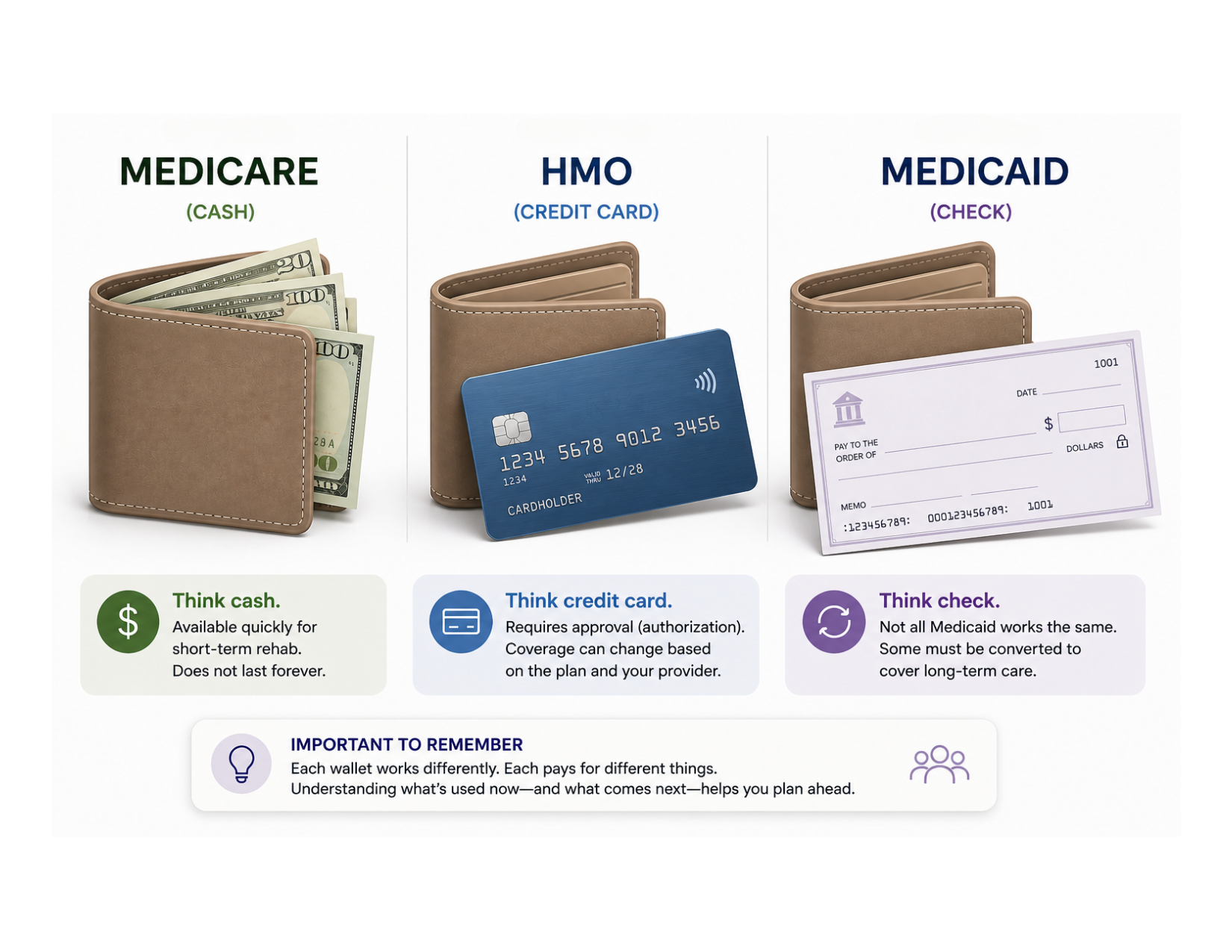
Medicare is like cash: Just like cash is readily available when you need to make a purchase, Medicare offers a more direct path to covered skilled nursing care, generally without the need for prior authorization.
Medicare Advantage & HMOs are like credit cards: Just like a credit card transaction may need approval before it goes through, these insurance plans may require prior authorization before certain services, including rehabilitation, can begin. The plan reviews the request to determine whether the care meets its coverage requirements.
Medicaid is like a check: Just like a check may need to be deposited, processed, and cleared before the money becomes available, Medicaid may require additional paperwork, eligibility review, or conversion to the appropriate nursing home coverage before it can pay for long-term care.
Understanding Rehabilitation, Skilled Nursing & Long-Term Care
Before getting into the differences between Medicare, Medicare Advantage, and Medicaid, it's helpful to understand the types of care these programs may help cover. Rehabilitation, skilled nursing, and long-term nursing home care are not all the same. While they can take place in the same facility, the purpose of the care, the length of stay, and how it's paid for can be very different.
Short-Term Rehabilitation: Working Toward Recovery
Imagine someone is hospitalized after a fall, hip replacement, stroke, or serious illness. They're medically stable enough to leave the hospital, but they're not quite ready to return home. They might need physical therapy to regain strength, occupational therapy to relearn everyday activities, or skilled nursing services to help manage their medical needs.
That's where short-term rehabilitation comes in. The goal is generally to help someone recover, regain independence, and safely return home or transition to the next appropriate setting. Rehabilitation may include:
Physical Therapy (PT): Improving strength, balance, mobility, and walking.
Occupational Therapy (OT): Helping with everyday activities like dressing, bathing, and getting around safely.
Speech-Language Pathology (SLP): Addressing swallowing, communication, or cognitive difficulties.
Skilled Nursing: Providing medically necessary services such as wound care, IV treatments, or other nursing interventions.
These services may be provided in a Skilled Nursing Facility (SNF), which is a nursing facility equipped to provide skilled nursing and rehabilitation services.
Long-Term Care: Ongoing Support
Now imagine someone whose needs extend beyond a temporary recovery period. Perhaps they have advanced dementia, significant mobility limitations, or medical and personal care needs that make living independently unsafe. Instead of focusing primarily on recovery and returning home, long-term nursing home care provides ongoing support with daily living, supervision, and medical needs. This might include assistance with bathing, dressing, eating, medications, mobility, and other everyday activities.
Here's the important distinction: A person can receive short-term rehabilitation and long-term care in the same nursing home, but the insurance coverage may be completely different. That's where understanding what's in your wallet becomes especially important.
What's in Your Wallet?
Medicare: The Cash
Medicare is a federal health insurance program primarily for adults age 65 and older, as well as certain younger individuals who qualify. Under Medicare, eligible patients may receive coverage for short-term skilled nursing facility care when specific requirements are met. For example, imagine someone is hospitalized after hip surgery and needs rehabilitation before returning home. If they meet Medicare's requirements for skilled nursing facility coverage, Medicare can help pay for that rehabilitation stay.
That's why I compare Medicare to cash. There's generally no private insurance company that needs to issue prior authorization before covered skilled nursing facility services can begin, so you can typically transition directly to rehab pending medical clearance. However, just because Medicare may pay for rehabilitation doesn't mean it will pay for someone to live in a nursing home permanently.
Medicare generally does not cover long-term care, such as ongoing assistance with bathing, dressing, or other daily activities when that is the primary care needed. For example, someone might complete their rehabilitation but still be unable to safely return home. If they no longer require covered skilled services, Medicare generally won't continue paying simply because they need long-term nursing home care. In other words, the cash in your wallet may help pay for qualifying rehabilitation, but it isn't an unlimited source of funding for long-term care.
Medicare Advantage & HMOs: The Credit Cards
Medicare Advantage plans are offered by private insurance companies approved by Medicare. They provide Medicare-covered benefits, but they may have different provider networks, authorization requirements, and out-of-pocket costs. Some Medicare Advantage plans are HMOs, while others have different plan structures.
I compare these plans to credit cards because receiving certain services may require an additional approval process (unlike cash). Imagine that same patient recovering from hip surgery, and the hospital recommends short-term rehabilitation but the patient has a Medicare Advantage plan. Before the patient can transition to a skilled nursing facility, often times the insurance company may need to review the request and authorize the rehabilitation stay. You have the same “cash” for Medicare but it’s on a card and can sometimes be declined.
Authorizations often involve documentation such as:
Physical and occupational therapy evaluations describing the patient's functional abilities and limitations.
Clinical notes explaining the patient's medical condition and skilled care needs.
Information about mobility, safety concerns, and the level of assistance required.
A proposed treatment plan and supporting medical documentation.
The insurance company reviews this information to determine whether the requested care meets its coverage criteria. And here's something else families should understand: An initial authorization doesn't necessarily mean the entire rehabilitation stay is approved. Some plans require continued reviews, updated therapy notes, and additional documentation to determine whether coverage should continue.
Just like a credit card transaction may require approval, rehabilitation under certain insurance plans may involve several steps before and during the stay. Medicare Advantage plans also generally do not cover long-term custodial nursing home care simply because someone needs ongoing assistance.
Medicaid: The Checks
Medicaid is a joint federal and state program that helps eligible individuals access healthcare services. Unlike Medicare, Medicaid may also help pay for long-term nursing home care when someone meets the applicable financial, medical, and program eligibility requirements. But having Medicaid doesn't automatically mean you have the right type of coverage for long-term nursing home care.
In New York, an important distinction is the difference between Community Medicaid and Chronic Care Medicaid. Community Medicaid generally helps eligible individuals receive healthcare services while living in the community, whether that's at home or in another community-based setting. Depending on the person's coverage and eligibility, this may include doctor visits, medications, and certain home care services. Chronic Care Medicaid, often called Nursing Home Medicaid, refers to Medicaid coverage for eligible individuals who require long-term nursing home care. This involves different financial and eligibility considerations than community-based coverage.
So, what happens when someone already has Community Medicaid but now needs permanent nursing home placement?
Their Medicaid coverage may need to be converted from Community Medicaid to Chronic Care Medicaid.
This is where my check analogy comes in. Think about receiving a check. Just because you're holding it doesn't mean the money is immediately available to spend. The check may need to be deposited, processed, and cleared first. Medicaid can work in a similar way. Someone might already have a Medicaid card in their wallet, but that doesn't necessarily mean their coverage is ready to pay for long-term nursing home care. Their case may need to go through a conversion process to establish the appropriate nursing home coverage.
Depending on the individual's circumstances, this process may involve:
Financial Review: Reviewing income, assets, and other financial information to determine eligibility.
Medical Eligibility: Establishing that the individual requires the appropriate level of nursing home care.
Documentation: Submitting applications, financial records, and other required paperwork.
Coverage Conversion: Updating an existing Community Medicaid case to reflect the need for long-term nursing home coverage.
Asset Review: Examining certain financial transfers during the applicable look-back period.
What About the Five-Year Look-Back?
Another important consideration for Chronic Care Medicaid in New York is the five-year look-back period.
When someone applies for Medicaid coverage of long-term nursing home care, the state generally reviews certain financial transactions and asset transfers made during the previous 60 months. For example, if someone gave away a significant amount of money or transferred property to a family member during that period, the transfer may need to be reviewed to determine whether it affects Medicaid eligibility. Not every transfer results in a penalty, and exceptions may apply. That's why families should consult a qualified elder law attorney or Medicaid planning professional before transferring assets or making major financial decisions.
When developing the wallet concept, I also considered comparing this conversion like changing from everyday clothes into pajamas: Medicaid is Medicaid, but you're changing it into something better suited for a different setting (nursing home). But Community Medicaid is like having a check in your wallet. Chronic Care Medicaid is like having that check processed and cleared for its intended purpose.
The coverage may already exist, but additional steps can be necessary before it's established for long-term nursing home care. And just like waiting for a check to clear, the process can take time. That's why understanding the difference between Community Medicaid and Chronic Care Medicaid before a loved one needs nursing home placement can be so helpful.
The goal isn't to become a Medicaid expert. It's simply to understand that having Medicaid and having Medicaid coverage established for long-term nursing home care aren't always the same thing.
Bringing It All Together
The easiest way to remember the differences is to think about the purpose of each type of coverage.
Medicare (Cash): May cover qualifying short-term skilled nursing and rehabilitation services, but generally not long-term custodial care.
Medicare Advantage & HMOs (Credit Cards): May cover qualifying rehabilitation, often with additional requirements such as prior authorization, network participation, and ongoing clinical reviews.
Medicaid (Check): May help cover long-term nursing home care for eligible individuals, sometimes requiring additional applications, financial reviews, or changes in coverage.
Of course, every insurance plan and patient situation is different. The Wallet Concept isn't intended to explain every coverage rule or exception. It's simply a way to make an overwhelming system a little easier to understand, especially when families are being asked to make important decisions in a short amount of time. My goal isn't to provide insurance or financial advice, but to make complicated information a little more approachable and encourage conversations that help people feel informed.
This article is intended for general educational purposes and is not a substitute for individualized insurance, legal, or financial guidance. Coverage and eligibility vary by plan, state, and individual circumstances. Always confirm benefits and requirements directly with your insurer, Medicare, Medicaid, or a qualified professional.